

TÜV-certified welder
Measure: International welder
- Measure number: 325/45/2024
Welding is "the non-detachable joining of components using heat and/or pressure, with or without filler material". Of all the processes, fusion welding is the best known.
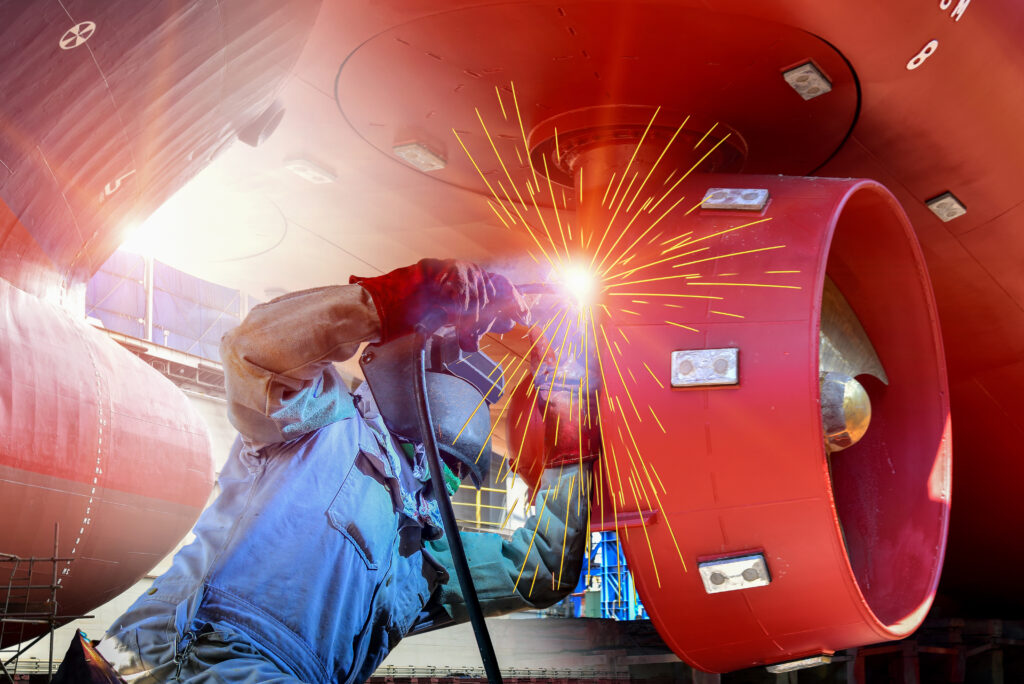
The basic package for training as a TÜV-certified international welder!
The qualifications at our facility are carried out according to the recommended training guidelines. In welding technology in particular, our training centre adheres to the DIN EN ISO 9606-1 and 2 standards. From a total of 24 modules (E-hand, MAG, TIG ST, TIG CrNi), we can create your individual training plan.
To begin, you will do a practical exercise, the so-called manual dexterity test. This will allow us to see what you already know and which modules you still need for your training. If you wish, you can do an internship. During this, we will look together to see if the profession suits you and if you really want to do it.
Training process:
Practice You are practising welding on special workpieces according to plans from TÜV Rheinland.
Exams At the end of each module, there are tests and assessments.
Qualification Our training meets the official examination standards DIN EN ISO 9606-1/2.
Conclusion We'll help you find a job. You'll also receive targeted training for your future tasks, ensuring a smooth transition into employment.
German for Work During your training, you can also learn German for the workplace. In this course, you will learn important words and phrases from everyday working life. The lessons are offered if you still need support with the language of your profession.
The modules
Manual metal arc welding or shielded metal arc welding (Modules 1-6)
Arc welding is a fusion welding process that is used to weld metals. An electric arc generated by a direct or alternating current source produces intense heat that melts the metal at the joint between two workpieces. Where is manual arc welding used?
Manual arc welding is mainly used to join sheets and pipes made of unalloyed steels as well as cast steel and cast iron. Examples: Steel and metal construction, mechanical engineering, apparatus engineering, bridge construction, pipeline construction, locksmith work
MAG Welding (Modules 1-6)
MAG welding (welding using active gases) is an inert gas welding process and is used to weld different metals with an arc under an active gas. Where is MAG welding used? MAG welding is mainly used to join sheets and pipes made of unalloyed and high-alloy steels. Examples: Vehicle construction, structural engineering, steel construction, container construction, locksmith work, railing production, mechanical engineering.
TIG Welding ST (Modules 1-6)
Tungsten inert gas welding (TIG) is a gas-shielded welding process in which a non-consumable electrode made of pure or alloyed tungsten is used.
Where is TIG ST welding used? TIG welding is used to join sheets and pipes made of unalloyed and low-alloy steels. Examples: Pipeline construction, apparatus engineering, tank construction, power station construction, mechanical engineering
TIG welding CrNi (Modules 1-6)
Tungsten inert gas welding (TIG) is a welding process with shielding gas in which a non-consumable electrode made of pure or alloyed tungsten is used. Where is TIG CrNi welding used? TIG CrNi welding is used to join sheets and pipes made of high-alloy steels. Examples include Pipeline construction, apparatus engineering, tank construction, power station construction, commercial kitchen equipment construction, hospital locksmiths, beverage and food industry